Missed Calls Are Missed Opportunities: What Happens When No One Answers?
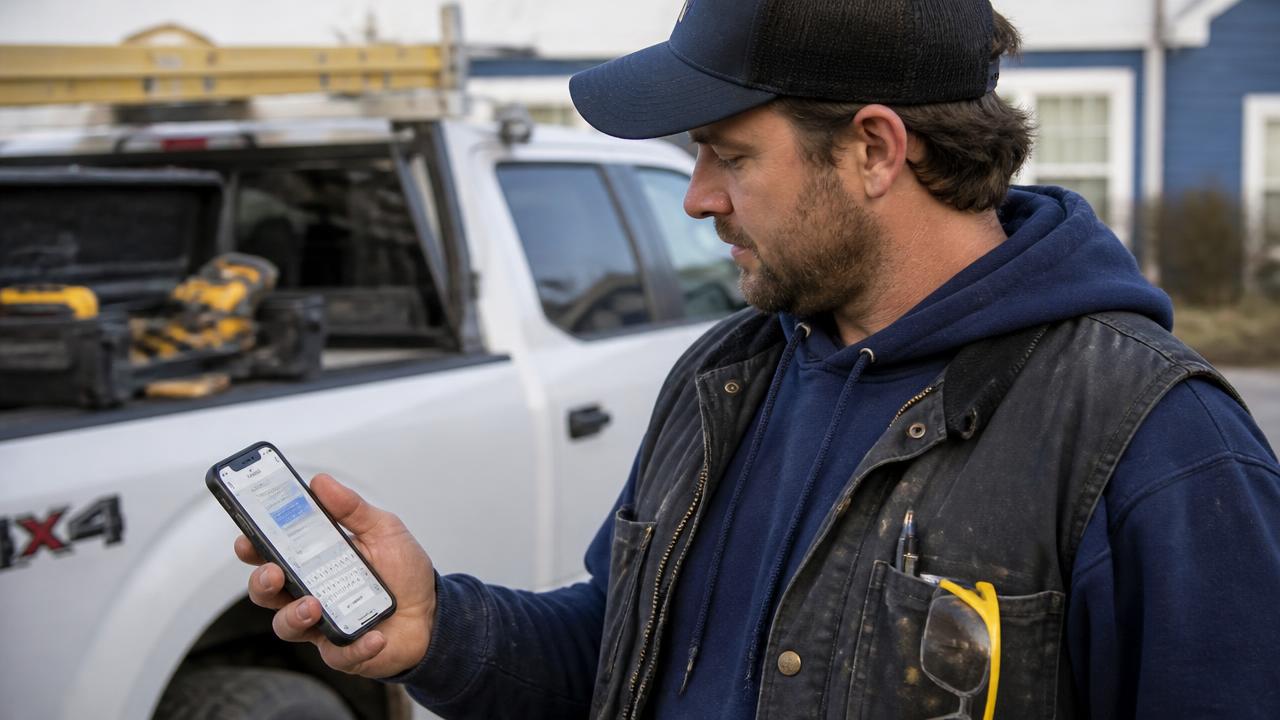
Every service business owner has looked down at a phone screen and seen the same thing: one missed call, no voicemail, unknown number. Maybe it was a supplier. Maybe it was a homeowner with water running across a basement floor who has already dialed the next company on the list. You will probably never know.
The goal of this article is not to convince you to answer every call. That is not realistic when you are on a roof, in a crawlspace, running a machine, or standing in front of a customer. The goal is to make sure a missed call does not automatically turn into a missed opportunity.
You can't always pick up the phone
Think about a normal Tuesday. A roofer is on a steep pitch with a nail gun in his hand. An excavator operator is in the cab with the radio on. An HVAC tech is in an attic in July. A commercial cleaning crew lead is walking a client through a punch list. A welder has a hood down and an arc struck. In every one of those moments, the phone is either out of reach, unhearable, or genuinely unsafe to answer.
This is not a discipline problem or a work-ethic problem. It is a structural reality of field work. The businesses that grow are not the ones that magically answer 100 percent of calls. They are the ones that built something to catch the calls they could not answer.
What happens from the customer's perspective
Put yourself in the caller's shoes. Most people calling a service business are not casually shopping. Something is broken, leaking, sparking, overgrown, or overdue. They are in a problem-solving mindset and they want a human response.
When the phone rings out, that caller does not think "they must be busy serving customers, I will try again this afternoon." They think "no answer" and they move to the next search result. Often they are calling from a list they built in about ninety seconds. Whoever responds first gets to have the conversation. That is the whole idea behind speed to lead: the first meaningful response usually wins the job, not the lowest price.
Speed to lead equals revenue. The company that responds first is usually the company that gets to quote.
Why voicemail alone is not enough
Voicemail was designed for a different era of communication. It still has a place, but relying on it as your safety net creates three problems.
- Most people simply will not leave one. Leaving a voicemail feels like extra effort with an uncertain payoff, so callers hang up and dial someone else.
- Voicemail is one-directional. Even a good message gives you a name and number, but no conversation has started and nothing is scheduled.
- Voicemails get missed twice. The call gets missed in the field, then the message sits unheard until the end of the day — or until the phone gets handed to someone in the office who does not know the context.
Voicemail can still be part of your setup. It just should not be the only thing standing between a missed call and a lost customer.
What is missed-call text back?
Missed-call text back is exactly what it sounds like. When a call to your business number goes unanswered, the system automatically sends that caller a text message within seconds. No one has to remember to do it, and no one has to stop working.
A good message is short, human, and specific. Something like: "Hi, this is Dave with Ridgeline Roofing. Sorry we missed your call — we're on a job site right now. Can you tell me what you need help with and the address? I'll get right back to you."
Notice what that message does. It identifies the business, explains the silence, asks a question, and gives the customer something easy to do. It also moves the conversation into text, which is a channel most homeowners and property managers can respond to while they are at work or standing in the problem area taking photos.
One thing to be clear about: this is not a trick to avoid talking to customers. It is a bridge that keeps the door open until a real person can pick the conversation up.
What should happen after the customer replies?
This is where most setups fall apart. The automated text goes out, the customer answers, and the reply lands in a phone that nobody is watching. You have created a faster way to ignore people.
A complete missed-call system does four things after the reply comes in:
- Creates a lead record. The caller's name, number, and message land in your CRM as a new opportunity, not in a text thread on one person's phone.
- Notifies the right person. The office manager, dispatcher, or whoever owns first response gets an alert immediately.
- Captures the details. A short set of questions — what's the issue, what's the address, is it urgent — gives whoever calls back enough context to be useful.
- Ends with a next step. Either a booked appointment, a scheduled callback time, or a quote in progress. A conversation with no next step is not a lead, it is a chat.
Automation should support the team, not replace it
Nobody hires a plumber because they enjoyed the text message. They hire the plumber who showed up, explained the problem plainly, and fixed it. Automation does not sell your work — your people do.
What automation is genuinely good at is the boring, time-sensitive part: acknowledging a caller within seconds, logging the lead, reminding someone to follow up on day two and day five, and making sure nothing sits in a gray zone. That frees your crew and your office to spend their attention on quoting, scheduling, and the actual conversation.
A practical rule: let the system handle the first touch and the reminders. Let a human handle the diagnosis, the price, and the commitment.
Your advertising is only as good as your follow-up
If you are running Google Ads, boosting posts, paying for a service directory listing, sending mailers, or wrapping trucks, you are paying to make the phone ring. Every one of those dollars is spent before the call arrives.
So when a call goes unanswered and nothing happens afterward, you did not just lose a job — you paid full price for a lead and then threw it away. Fixing follow-up is usually cheaper and faster than buying more leads, and it makes every marketing dollar you already spend work harder.
A simple missed-call workflow
You do not need anything complicated. Here is a workflow that fits almost any local service business:
- Call comes in and goes unanswered after a set number of rings.
- Automatic text goes out within about a minute: apology, who you are, and one clear question.
- A lead record is created in the CRM with the phone number, time, and source.
- The person responsible for first response gets a notification on their phone.
- Customer replies and the conversation continues by text or a callback.
- The lead is moved to a stage — quoted, scheduled, or not a fit — so nothing floats.
- If there is no reply, an automated follow-up goes out later that day and again a couple of days after.
That is it. Seven steps, most of them running on their own in the background.
What should you measure?
Once the workflow is live, keep an eye on a small number of things. You do not need a dashboard with twenty charts.
- How many calls go unanswered in a typical week, and when they cluster.
- How many of those callers respond to the text back.
- How long it takes a real person to respond after the customer replies.
- How many missed-call leads turn into quotes, and how many of those turn into booked jobs.
Those four numbers will tell you more about your revenue ceiling than almost anything else on your desk. If unanswered calls spike every Thursday afternoon, that is a staffing insight. If people reply to the text but nobody calls back for six hours, that is a process problem you can fix this week.
Key takeaway
You will miss calls. Everyone in the trades does, and no scheduling change is going to eliminate that. What you can control is what happens in the sixty seconds after the ringing stops.
A missed call is only a missed opportunity when nothing catches it. With an automatic text back, a lead record in the CRM, a notification to the right person, and a follow-up sequence behind it, that same missed call becomes a conversation you can still win.
Stop Losing Leads. Start Building Better Systems.
MainStreet Systems helps local service businesses capture leads, respond faster, automate follow-up, stay organized, and turn more opportunities into booked revenue.
Get My Free Business Assessment