What Happens After 5 PM? How Service Businesses Can Capture Leads After Hours

A lot of service businesses think of lead response as something that happens during office hours. The phones are answered from eight to five, forms get checked while someone is at a desk, and everything after that waits until tomorrow. That might be how the business runs, but it is not how customers search for help.
A homeowner may start looking for a roofer at 8 PM after seeing water spots on the ceiling. A property manager may request a commercial cleaning quote after the tenants leave for the day. A restaurant owner may notice an electrical issue after closing. The business does not need to pretend a person is available twenty-four hours a day, but it does need a dependable way to acknowledge and capture the opportunity.
Your business may close at 5. Your customers don't.
Most local service buyers are busy during the same hours you are. They work, manage kids, run crews, sit in meetings, and deal with problems when the day finally slows down. Evening is often when they have time to search, compare, and send a request. If your system goes silent after hours, the customer is left guessing whether the message was received at all.
That silence matters because the customer's problem still feels urgent to them. A plumbing leak at 7:30 PM may not require an emergency dispatch, but the person holding the phone still wants to know someone heard them. A quick acknowledgment can be the difference between waiting for your call tomorrow and contacting three more companies tonight.
What happens to an after-hours lead?
In many shops, the after-hours lead lands in a form notification, a voicemail box, or a general inbox. Nobody sees it until morning. By then, the customer may have forgotten which company they contacted, booked with a competitor, or lost confidence because there was no immediate response.
This is especially common for roofers, HVAC companies, electricians, excavators, landscapers, welders, and cleaning companies that have field-heavy teams. The owner is not ignoring people. The team is just done for the day. The missing piece is a system that catches the lead while everyone is offline.
Silence creates uncertainty
When a customer fills out a form and nothing happens, they do not know if it went through. When they call after hours and hear a generic voicemail, they do not know when anyone will call back. Uncertainty pushes people to keep searching. They are not trying to be difficult; they are trying to reduce risk.
An after-hours lead response for service businesses should remove that uncertainty. It should confirm the request, set expectations, ask for the basic information your team needs, and make the next step clear. That is enough to keep the opportunity warm until a human can follow up.
An immediate acknowledgment changes the experience
A good after-hours message does not pretend someone is sitting at a desk. It tells the truth in a helpful way: thanks for reaching out, we received your request, our team will review it in the morning, and here is what we need from you to help faster. That kind of message feels professional because it is clear and honest.
For example, a message might say: Thanks for contacting Main Street Roofing. Our office is closed, but we received your request. Reply with the property address, a short description of the issue, and any photos you have. Our team will follow up tomorrow morning. That is not pushy. It is useful.
What can be automated after hours?
- A text or email confirming that the inquiry was received.
- A short request for address, service type, urgency, and photos if helpful.
- A CRM record so the lead does not live only in an inbox or voicemail.
- A notification to the owner, office manager, dispatcher, or sales person responsible for first response.
- A task for the next business morning with the customer's information attached.
Those steps are repetitive, time-sensitive, and easy for a system to handle correctly every time. They do not require judgment. They simply make sure the opportunity is captured and visible.
What should wait for a human?
Automation should not diagnose the issue, quote a price, promise a crew, or pretend a real person is available when one is not. A homeowner with an electrical problem deserves a trained person making the call. A commercial cleaning prospect asking about scope needs a real conversation. A customer upset about a plumbing emergency should not be handled by a generic sequence.
The purpose of automation is to acknowledge, capture, organize, and route. The relationship still belongs to the business owner and the team. That boundary keeps the customer experience honest and protects trust.
Capture the information your team needs
The next morning is much easier when the lead record already includes the basics. For a roofer, that may be the address, roof issue, leak location, and photos. For an HVAC company, it may be system type, symptoms, and whether the unit is completely down. For a commercial cleaning quote, it may be building size, frequency, access requirements, and desired start date.
Do not ask for twenty fields after hours. Ask for enough to make the first human call useful. The customer should feel like the process is moving, not like they are filling out paperwork.
Start the next morning with organized opportunities
Without a CRM, morning follow-up often starts with hunting through missed calls, emails, website forms, and social messages. That creates delay before the team even begins responding. With a simple lead pipeline, every after-hours inquiry can already be sitting in one place with a source, timestamp, contact information, notes, and an assigned next step.
That means the office manager does not have to ask who saw what. The owner does not have to scroll through texts. The first response list is ready. This is where service business automation is most valuable: it reduces morning confusion so people can make better human calls faster.
A simple after-hours lead workflow
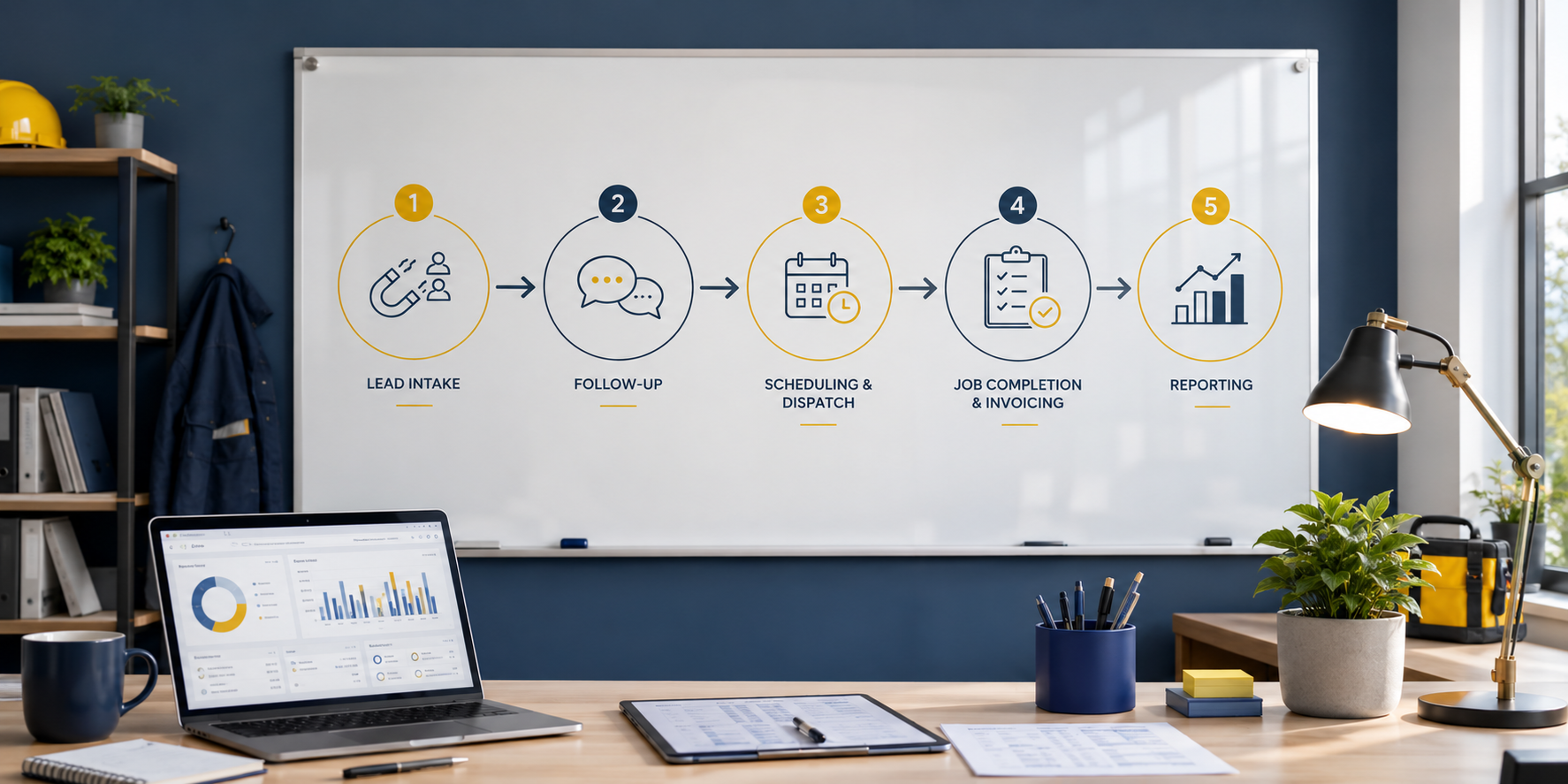
A practical workflow can be simple: New After-Hours Inquiry → Immediate Acknowledgment → Basic Information Captured → Lead Added to CRM → Team Notified → Human Follow-Up.
Every step has a purpose. The acknowledgment reassures the customer. The information request gives the team context. The CRM keeps the opportunity visible. The notification creates ownership. The human follow-up turns the captured lead into a real conversation.
The key takeaway
You do not need someone answering phones all night to compete after hours. You need a system that responds honestly, captures the right information, and makes sure the next business day starts with organized opportunities instead of scattered messages.
Speed to Lead = Revenue. Even after hours, the first clear acknowledgment can keep the opportunity alive until your team can follow up.
Stop Losing Leads. Start Building Better Systems.
MainStreet Systems helps local service businesses capture leads, respond faster, automate follow-up, stay organized, and turn more opportunities into booked revenue.
Get My Free Business Assessment